Follow the source trail (4)
- Manx Notebook: Castletown windmill research ↗
Historical research quoting 1828–1829 newspapers
- Museum of Witchcraft and Magic: institutional history ↗
Museum’s own history; Castletown and Boscastle distinguished
- Manx Notebook: annotated Museum souvenir guide ↗
Later promotional text and critical commentary
- Ronald Hutton: The Triumph of the Moon, Oxford Academic ↗
Scholarly history of modern Pagan witchcraft
Three histories share an address
The Castletown Witches Mill is an excellent place to begin a field guide because several histories have become attached to one site. There is the history of a windmill as a working building. There is the twentieth-century museum associated with Cecil Williamson and Gerald Gardner. There are also the stories used to explain the museum and its objects to visitors. Those histories can enrich each other, but none should silently stand in for the others.
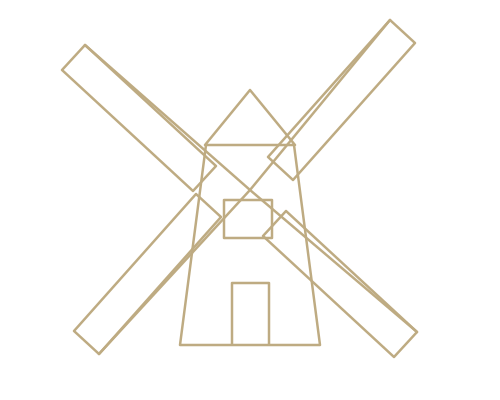
Our illustration is an original stylised drawing, not a measured reconstruction or archival photograph. The museum is not an attraction you can visit at this address today. The later historical account describes residential conversion. This page is a source-reading feature, not a route through private property or a claim about current access.
Begin with the building evidence
The Manx Notebook’s windmill feature reproduces newspaper accounts through historical research by J. K. Qualtrough. It places construction in 1828 and records storm damage in the following year. That is a different evidential route from the museum souvenir’s claim that the mill already existed in 1611. The editor identifies a confusion between a watermill and the later windmill.
This matters because the two dates are not simply competing estimates for an unknown building. They point towards a question of identification. Before debating which date is older, ask whether the sources are referring to the same structure. A site name, a nearby mill and an attractive narrative can become entangled. Keeping the object of the claim precise is the first repair.
The museum era is its own story
The Museum of Witchcraft and Magic’s institutional history dates Williamson’s Isle of Man centre to 1951 and identifies Gardner as its resident witch. Williamson’s later Boscastle museum opened in 1960. Those locations need to stay distinct. An institutional connection does not make every object, display or date interchangeable between museums.
The annotated Castletown guide supplies further museum-era ownership and succession information, including reported dates of 1954 and 1964. We label those as information reported by that later account, not deeds inspected by this project. The same caution applies to its account of closure in the early 1970s. A small source trail is stronger than a confidently precise chronology assembled without checking how each date entered it.
A guide can be evidence of storytelling
A souvenir guide asks a visitor to see a place in a particular way. Its arrangements, explanations and claims are therefore useful evidence for the museum’s presentation. They are not automatically proof of the remote past described by that presentation. Read the original promotional voice separately from the later editor’s brackets. The brackets have their own author, purpose and date.
Notice which statements the guide asserts and which it demonstrates. A compelling explanation of a name or a dance may contain no route back to a contemporary record. That does not make the guide useless. It changes what you can learn from it: how an attraction framed witchcraft for its audience, rather than a settled origin for every belief it displayed.
What stays out of the history
We do not repeat the guide’s sweeping persecution totals or claim an uninterrupted Stone Age religion as an established finding. Nor do we borrow a colourful execution story to supply a verified location, motive or biography where the original record has not been checked. Those are substantial claims about people and history. Atmosphere is not a substitute for evidence.
The later editor’s criticism should also be read critically. A corrective voice can identify a valuable contradiction while expressing attitudes that this site need not adopt. Historical precision does not require ridiculing a modern religious community. Describe the correction you can support; leave unnecessary judgements behind.
A useful visit to the page
Open the windmill account and the museum guide in separate tabs. Write one building claim and one museum claim on a research card. Record what each source is, then ask whether the material is contemporary, a later account or an interpretation. Compare dates only after you have identified the building and the kind of evidence being used.
Finish with a short statement of scope: this note concerns a nineteenth-century windmill and twentieth-century museum storytelling; it does not establish every claim in the souvenir. That sentence helps the next reader understand why some dates appear in our timeline and others sit in the disputed-claim drawer. You can enjoy the strangeness of the cabinet while knowing exactly where the historical floor is solid and where questions remain.