Follow the source trail (3)
- Historic England: what are witches’ marks? ↗
Heritage interpretation with competing explanations
- Historic England: protective and carpenters’ marks ↗
Heritage interpretation
- Jennifer Alexander: Stonemasons’ Marks, Routledge ↗
2026 academic study; publisher description
Look before you name
A circle in old timber is an observable shape. Calling it a protective mark is an interpretation. Calling its maker a witch adds another claim entirely. Keep those steps separate. Begin a notebook entry with what you can actually describe: the material, the shape, its position and the conditions under which you saw it. You do not need an exciting label before an observation becomes worth recording.
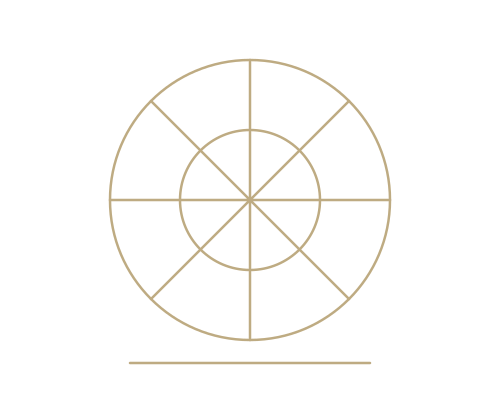
The phrase witches’ marks is widely used in heritage interpretation, but it can mislead a first-time reader. In the protective interpretation, the marks are generally understood as intended to ward off danger, not as a signature left by a persecuted person. Even that interpretation requires context; a visual resemblance alone does not establish purpose.
Several explanations can fit a shape
Historic England discusses protective interpretations alongside practical carpenters’ marks and disputed readings of letter-like forms. Its material on hexafoils also acknowledges competing interpretations. These distinctions are not obstacles to enjoying old buildings. They make the buildings more interesting, because a trace can preserve work, belief, practice or several layers of use.
Jennifer Alexander’s 2026 study Stonemasons’ Marks examines the functional significance of marks in construction. It provides a useful reminder to place a proposed supernatural explanation beside an account of making and assembling a building. A book description does not settle the meaning of a particular mark you have seen; it identifies a further line of inquiry. Use a comparison of arguments rather than a competition between eye-catching headlines.
Record a location without trespassing
Only observe places you can lawfully access. Follow the site’s photography rules, keep away from fragile fabric and do not touch, chalk, rub, carve or burn anything to make a shape clearer. A faint observation is preferable to damage. If an exact location would expose a private home or sensitive site, keep it in your private notes rather than publishing it.
Write a practical description such as above an internal doorway or on a timber beam, if that is what you can verify. Avoid assigning a date to a mark just because the building has a known construction date. A building can be altered, repaired and reused. A mark may belong to one of those later moments. The date of the material and the date of the intervention need not be the same.
Use a two-column note
On the left, write observation. On the right, write interpretation. Observation might include an overlapping pair of curves, a line that appears interrupted, or a shape partly hidden by later paint. Interpretation might include a protection hypothesis, an assembly system or a drawing exercise. Under each interpretation, write the evidence you would need to assess it.
For an assembly hypothesis, nearby corresponding marks might matter. For a geometric exercise, repeated attempts and varied accuracy might be relevant. For a protective hypothesis, position and comparable documented examples might be discussed by a specialist. These are directions for research, not a checklist that automatically proves an answer. Do not turn a plausible feature into a universal test.
When disagreement is the result
A good caption can end with uncertainty. Try: circular mark, photographed with permission; date of marking unknown; several interpretations remain possible. It is short, useful and honest. It tells another observer where to begin. A more elaborate caption should identify whose interpretation you are reporting and the publication in which you found it.
If you later encounter a stronger argument, update the interpretation while retaining the original observation. That separation protects your work from becoming obsolete every time the debate changes. It also lets you show why a correction was made, rather than simply replacing one confident label with another.
For a creative exercise, draw an original geometric pattern on paper and label it a modern design. Studying a historic form does not require reproducing an object’s claimed power or marking a building. Our making desk uses paper, pencils and blunt-ended tools; the outcome is a research aid or decoration, never a promise of protection.